Across Australia, AI activity is accelerating rapidly. New pilots are launched every month, teams are experimenting with generative AI tools, and organisations are investing in platforms, licences, and capability uplift initiatives at unprecedented speed.
Yet most boards and executive teams are still asking the same fundamental questions: Where is the measurable enterprise value? Can we trust it? Is it embedded in how work gets done?
Despite growing AI adoption, many organisations continue to struggle to translate experimentation into sustained operational impact, workforce transformation, or measurable board-level outcomes. The issue is rarely the technology itself. More often, the challenge is governance, operating model maturity, accountability, and organisational capability.
| Quick Answer: What Is the AI Value Gap? The AI value gap is the disconnect between AI activity and measurable business outcomes. Many organisations are investing heavily in AI tools, pilots, and experimentation, yet struggle to generate sustained enterprise value. The issue is not simply technology adoption. It is the absence of the governance, operating model discipline, accountability, and workforce capability required to scale AI effectively. This is why so many AI initiatives remain highly visible but commercially shallow. |
At Alchemy Impact, we see this pattern consistently across Australian organisations. AI activity continues to increase, but confidence in enterprise value is not keeping pace.
The organisations achieving the strongest outcomes are not necessarily moving fastest. They are applying greater discipline around where AI should create value, how it should be governed, and how it should be embedded into operational workflows.
Why AI Adoption Is Not Translating Into Enterprise Value
Global executive research from the Return on AI Institute (2026) indicates that AI underperformance is rarely caused by a lack of access to technology. In fact, many organisations already have widespread access to highly capable AI tools.
The challenge is that AI adoption is often driven by visibility and experimentation rather than disciplined value creation.
The data highlights a striking disparity:
- Fewer than one in ten organisations (9%) deploying generative AI broadly report achieving high-value outcomes.
- By comparison, around half (50%) of organisations using analytical AI for clearly defined business problems report significant value creation.
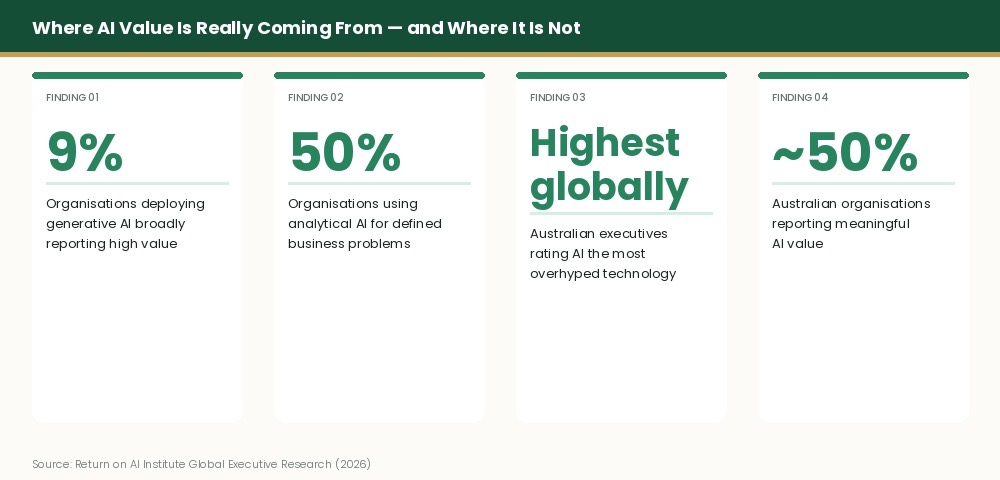
Key findings from the Return on AI Institute Global Executive Research (2026)
This distinction matters. High-performing organisations do not begin with the tool; they begin with the business problem.
Rather than deploying AI broadly and hoping value emerges later, they identify where AI can improve a specific operational outcome, establish measurable success criteria, define accountability, and redesign surrounding workflows to support scale. The result is narrower deployment, but significantly stronger enterprise outcomes.
The Three AI Value Gaps Preventing Organisations From Scaling AI
Across Australian organisations, three structural gaps consistently prevent AI from delivering sustained board-level value. These gaps are not theoretical. They are increasingly visible across governance discussions, workforce capability challenges, operational redesign programs, and executive-level investment decisions.
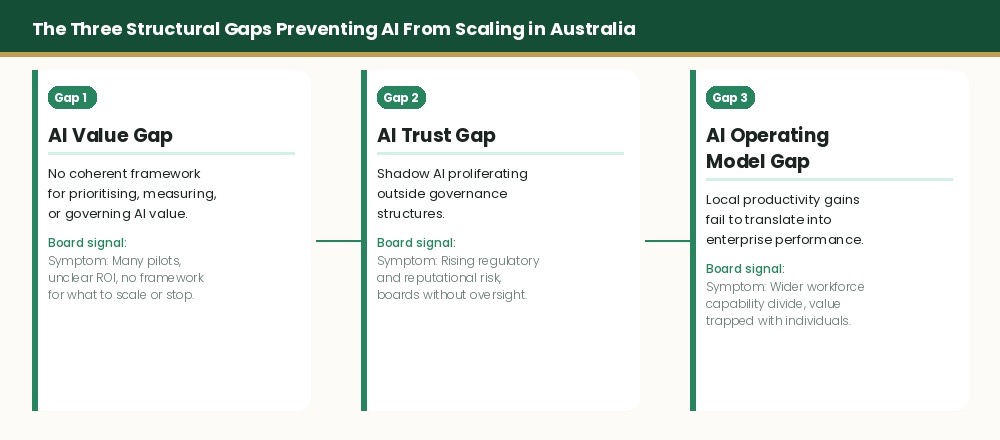
The three structural gaps identified in Alchemy Impact’s advisory work with Australian organisations
1. The AI Value Gap
The first challenge is the AI value gap itself. Many organisations are running multiple pilots without a coherent framework for prioritising, measuring, or governing value.
AI initiatives often begin with tool availability rather than a clearly defined business problem. Success metrics are vague, accountability is diffuse, and organisations struggle to determine which initiatives should scale and which should stop. This creates an environment where AI activity increases while confidence in commercial return declines.
Without a disciplined value framework, AI investment becomes increasingly difficult to defend at board level.
- The Thomson Reuters Future of Professionals Report (2025) found that only 14 per cent of Australian organisations currently have a formal AI strategy.
- Organisations with formal AI strategies reported materially stronger revenue growth outcomes than those without one.
The takeaway: The issue is not access to AI capability. It is organisational discipline around value realisation.
2. The AI Trust Gap
The second challenge is the AI trust gap. Across many Australian organisations, shadow AI is already emerging inside operational workflows. Teams are quietly embedding consumer AI tools into business activities without governance, oversight, or review standards. This creates growing regulatory, reputational, and operational risk.
- The Fifth Quadrant Australian Responsible AI Index (2025) highlights that only 12 per cent of Australian organisations currently demonstrate mature responsible AI capability.
- Research from the EY Australian AI Workforce Blueprint (2025) found that 72 per cent of workers remain concerned about breaching regulatory or data obligations when using AI at work.
This creates a dangerous combination: high adoption without sufficient governance maturity. As APRA’s April 2026 letter to industry makes clear, governance and assurance expectations are accelerating rapidly across regulated industries. Organisations that defer governance are not avoiding risk. They are accumulating it.
3. The AI Operating Model Gap
The third and often least visible challenge is the AI operating model gap. Many organisations are already seeing local productivity gains from AI. However, those gains frequently fail to translate into measurable enterprise performance improvement.
Why? Because surrounding workflows, decision rights, quality standards, and workforce capability have not evolved alongside the technology. A faster task does not automatically create a faster organisation.
- According to the Reserve Bank of Australia (2025), while around two-thirds of medium to large Australian firms have adopted AI in some form, nearly 40 per cent remain at minimal adoption, and only around 30 per cent have successfully embedded AI into core operational workflows.
- The Salesforce AI Worker Readiness Report (2025) found that only 41 per cent of Australian workers believe their workplace is prepared for AI adoption at scale.
This is not simply a technology issue. It is a workforce capability and operating model challenge. Without workflow redesign, governance integration, and organisational capability uplift, AI value remains isolated rather than systemic.
Why Australia’s Approach to AI Governance May Be an Advantage
Australia occupies an interesting position in the global AI landscape.
- Global research from the Return on AI Institute found that 45.5 per cent of Australian executives were among the most likely globally to describe AI as overhyped.
- At the same time, 51.5 per cent of Australian organisations report achieving a great deal of value from AI, placing Australia in the global top tier for AI value realisation, ahead of the global average of 44.8 per cent.
This is not a contradiction. In practice, scepticism can improve deployment discipline. Organisations that demand evidence, measurable outcomes, and stronger governance before scaling AI are often better positioned to avoid low-value, broad, and shallow deployments.
Caution, when applied correctly, becomes a filtering mechanism rather than a barrier to innovation. This is particularly relevant in publicly accountable and regulated environments. The National AI Centre’s Guidance for AI Adoption (2025) increasingly reinforces that responsible AI adoption is a leadership responsibility rather than a technical afterthought.
What High-Performing Organisations Do Differently With AI
The strongest performing organisations are not necessarily investing more heavily in AI. They are operating differently. Three behaviours consistently stand out.
They begin with outcomes, not tools. High-performing organisations define the business problem first. They quantify the operational or commercial impact of that problem and establish measurable success criteria before selecting technology.
They deploy narrowly and deeply. Rather than pursuing enterprise-wide rollout immediately, they focus on targeted workflows where value, risk, and accountability can be clearly managed. These deployments may attract less visibility than broad AI programs, but they are significantly more likely to generate measurable results.
They invest in AI literacy before scale. High-performing organisations understand that distributing AI tools is not the same as building organisational capability. They invest in shared language, governance standards, practical review capability, and workforce AI literacy before scaling adoption.
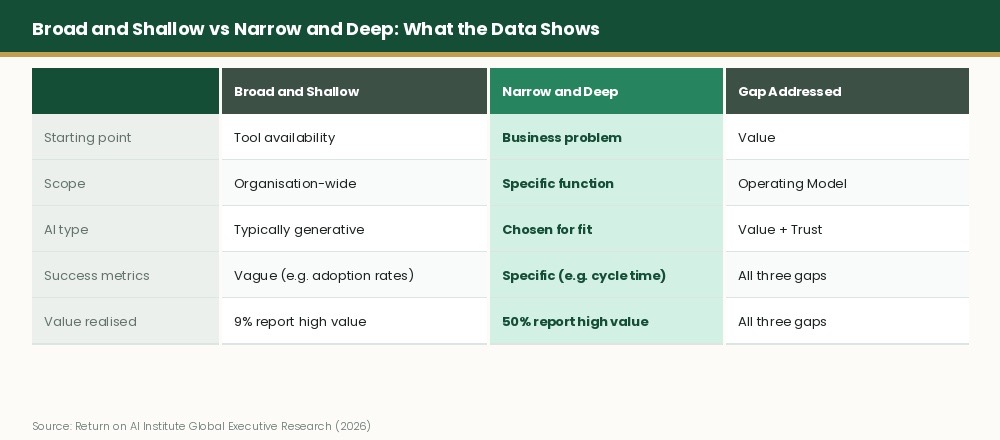
How deployment discipline separates high-performing organisations from those stuck in experimentation cycles
Why AI Literacy and Operating Model Design Matter
The workforce implications of AI are already visible. AI is reshaping how work is performed, how decisions are made, and what organisational capabilities are required to operate effectively.
Many organisations continue to approach AI as a technology layer added onto existing workflows. Sustainable value creation requires something much broader: workflow redesign, decision ownership clarity, governance integration, workforce capability uplift, shared operational standards, and responsible AI oversight.
AI value does not scale if organisational capability and operating rhythms remain unchanged. This is why AI governance, operating model design, and workforce AI literacy are becoming increasingly interconnected strategic priorities.
Download the White Paper
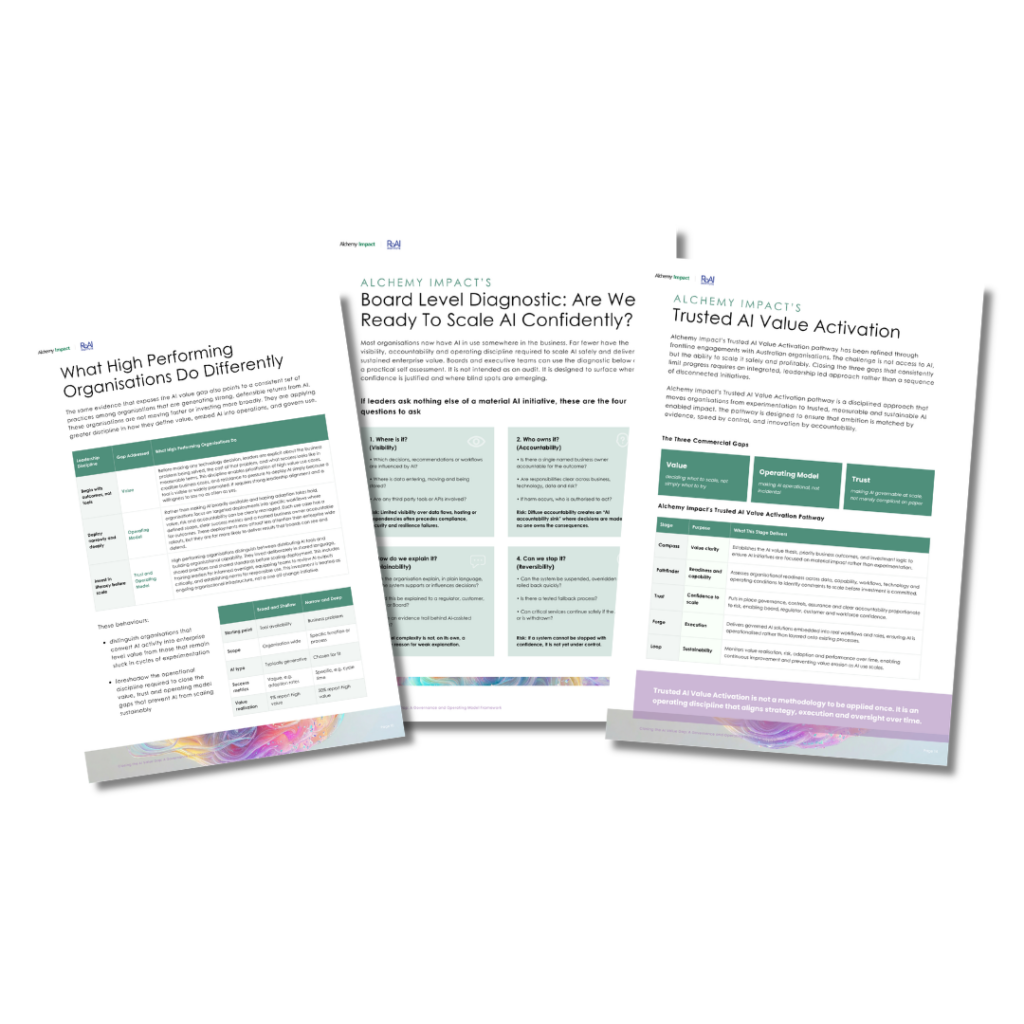
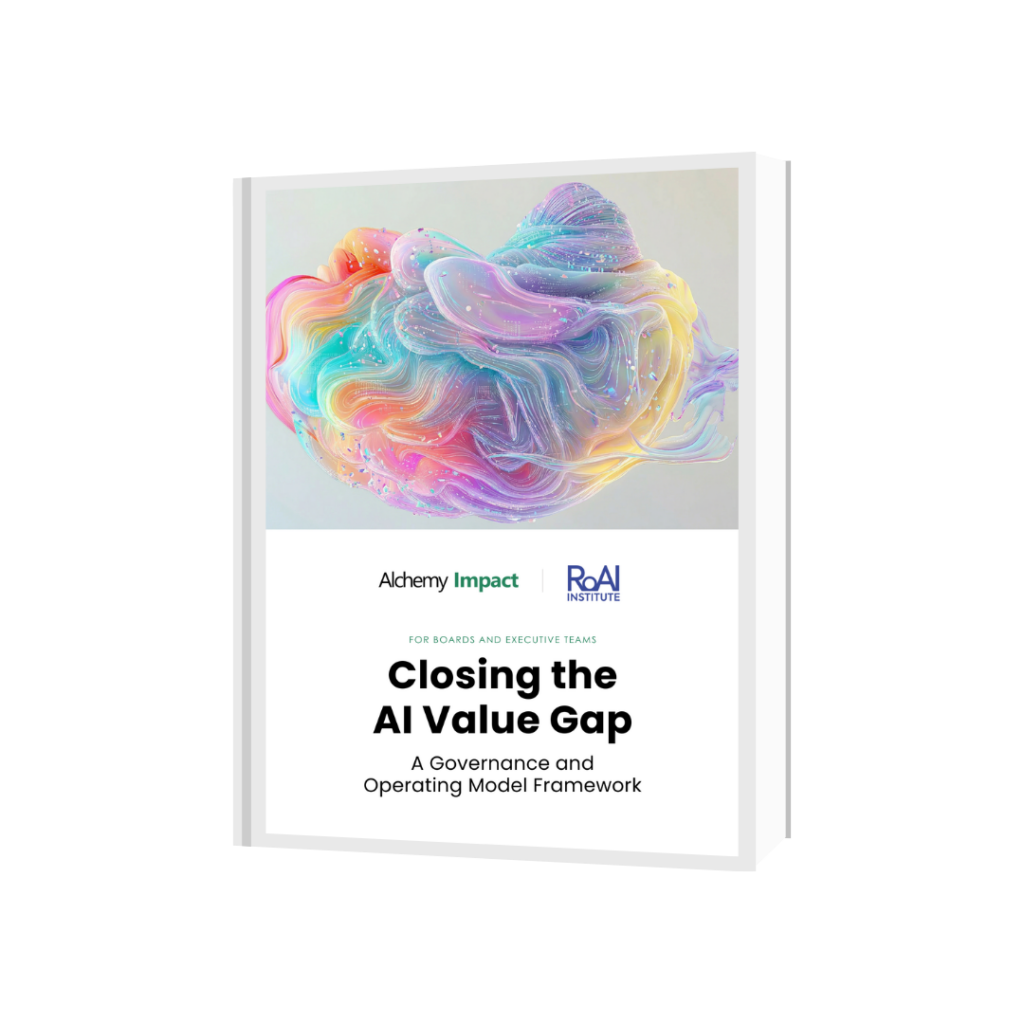
| Closing the AI Value Gap: A Governance and Operating Model Framework Download our latest white paper to explore the three gaps preventing AI from scaling successfully, why many AI initiatives fail to deliver measurable enterprise value, what high-performing organisations do differently, a practical board-level diagnostic for AI readiness, and Alchemy Impact’s Trusted AI Value Activation pathway. |
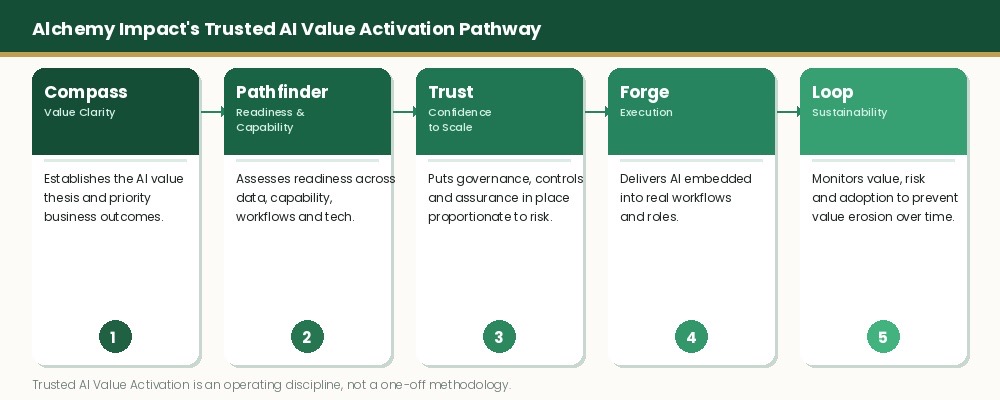
Alchemy Impact’s Trusted AI Value Activation pathway — from experimentation to measurable enterprise impact
Frequently Asked Questions
What is the AI value gap?
The AI value gap refers to the disconnect between AI adoption and measurable business outcomes. Many organisations are increasing AI activity without achieving sustained enterprise-level value. The gap is driven not by technology limitations, but by the absence of governance, accountability, and operating model discipline.
Why do most Australian AI initiatives fail to deliver board-level value?
Most AI initiatives fail because organisations focus on tools before defining business outcomes, governance structures, accountability, and operating model requirements. Without a coherent value framework, AI investment cannot be defended in a capital allocation conversation.
Why is AI governance important for Australian organisations?
AI governance helps organisations manage regulatory risk, improve accountability, and build trust while scaling AI adoption responsibly. APRA’s April 2026 letter to industry signals that governance expectations are accelerating across regulated sectors. Organisations that defer governance are accumulating risk, not avoiding it.
What is an AI operating model?
An AI operating model defines how AI is embedded into workflows, governance structures, decision-making processes, and organisational capability. It goes beyond tool deployment to address workflow redesign, decision ownership, and workforce capability uplift.
Why does AI literacy matter for enterprise value?
AI literacy helps organisations build workforce capability, improve governance maturity, and support responsible AI adoption at scale. Distributing AI tools is not the same as building the organisational capability required to realise sustained enterprise value.
How does Alchemy Impact help organisations close the AI value gap?
Alchemy Impact partners with boards and executive teams through its Trusted AI Value Activation pathway, a disciplined approach that moves organisations from AI experimentation to trusted, measurable, and sustainable impact across value, trust, and operating model dimensions.
Learn more: alchemyimpact.com.au
Related reading from our Learning Centre: