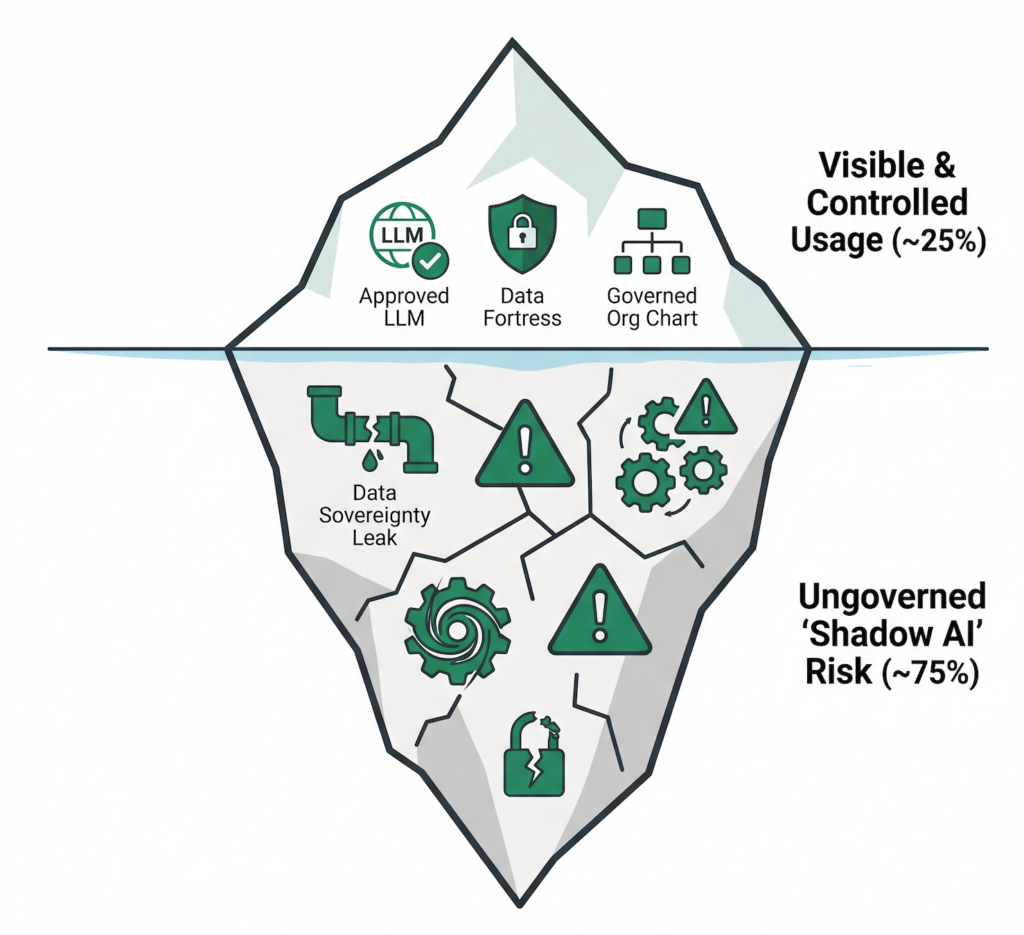
Nearly 75% of knowledge workers use AI informally. Consequently, this creates a visibility crisis for Australian organisations. In this article, we explore why AI literacy serves as your first line of risk management. Furthermore, we provide a structured, evidence led pathway to bridge the 82% productivity gap.
AI has already woven itself into the fabric of the modern office. Indeed, in Australia’s regulated sectors, the era of introducing AI has passed. Today, nearly three quarters of knowledge workers use these tools daily. However, most of this activity happens in the shadows. Consequently, it lacks formal guidance, clear guardrails, and executive oversight.
The challenge for leadership has shifted. You no longer need to ask if your teams use AI. Instead, you must ask if that usage remains visible and controlled. Furthermore, you must determine if it actually moves the needle on your business outcomes.
The Hidden Cost of Shadow AI
Decentralised adoption breeds invisibility. Specifically, the Microsoft & LinkedIn 2024 Work Trend Index highlights a striking trend: 75% of knowledge workers now use AI tools at work. In fact, most simply bring their own tools to the office.
In regulated environments like financial services or the NDIS sector, this creates a governance vacuum. Executives remain accountable for compliance and privacy. Yet, they often cannot see the landscape of Shadow AI they are accountable for. As a result, this lack of transparency creates more than just audit risks. It actively obstructs the path to measurable value. Simply put, you cannot manage what you cannot see.
Closing the 82% Productivity Gap with AI Literacy
If AI is everywhere, why isn’t it helping the P&L? The answer lies in the AI ROI gap.
Most organisations (around 80%) have deployed generative AI. Nonetheless, the McKinsey 2025 State of AI report reveals that these tools rarely move the needle on the bottom line. Our findings suggest a similar story. Specifically, 82% of enterprises fail to realise the productivity gains AI promises. Rarely does the technology itself fail. In contrast, organisational capability often falls short. Most initiatives stall because the workforce lacks the specific AI literacy required. Therefore, they cannot redesign their workflows around the tools. Instead, they use new tools to perform old, inefficient processes. Without a systematic reimagining of processes, AI remains a peripheral novelty rather than a core driver of business benefits such as improved employee productivity and operational efficiency.
Internal Insight: Tool deployment differs greatly from process improvement. Explore our analysis on Why Technology Alone Fails & How to Build Better Processes Before Automation to understand this fundamental shift.
AI Literacy as a Governance Capability
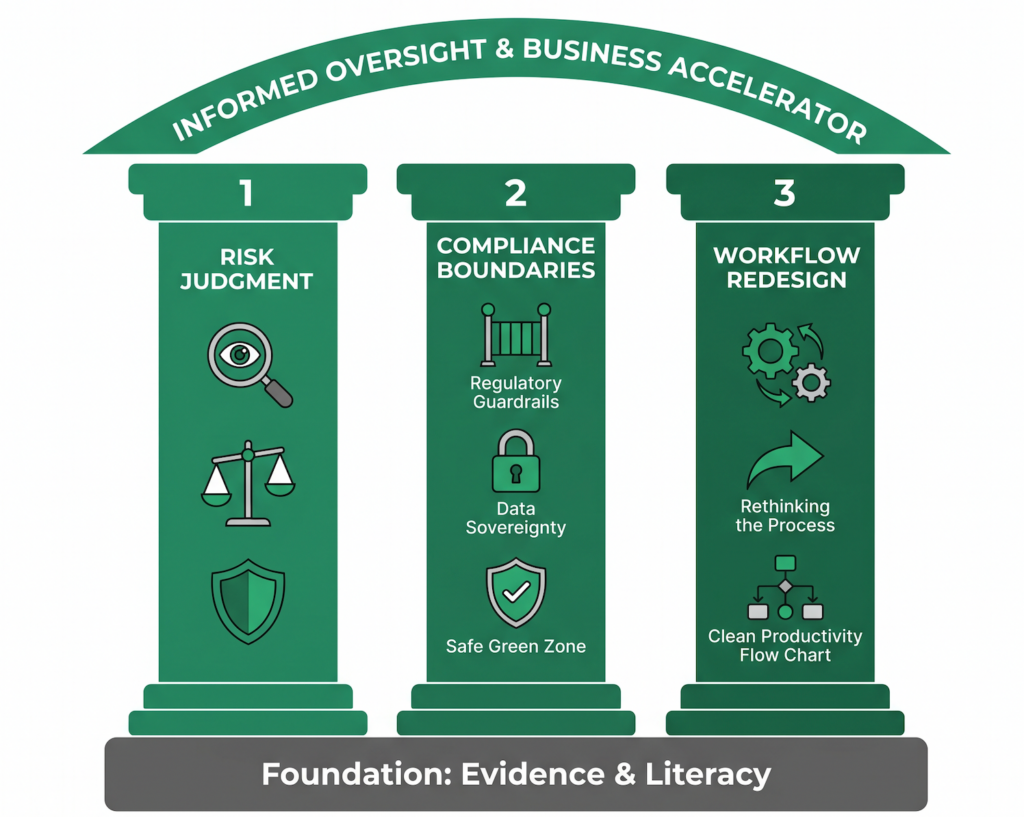
In high stakes environments, AI literacy means more than just upskilling. Indeed, it serves as a fundamental and foundational organisational governance capability.
Recent research, including the “The GenAI Divide” Study (2025), proves that literacy defines the difference between leaders and laggards. This goes beyond writing prompts. Specifically, it empowers your people to exercise judgment so they can identify algorithmic bias and respect compliance boundaries.
Therefore, boards and executives must build this literacy to move from uncontrolled experimentation to informed oversight. In doing so, they ensure that “right way” behaviours become part of daily operations. Ultimately, governance then functions as an accelerator rather than a barrier.
Related Strategy: To master modern oversight, read our guide on Data Governance vs. AI Governance: What’s the Difference?
A Decision Framework Built on Evidence
Scaling AI on a foundation of Shadow AI creates unnecessary risk. Consequently, prudent executives prioritise confidence over speed. They seek evidence before investment. To achieve this, at Alchemy Impact we advocate for a structured, evidence led pathway:
- Assess & Adapt: To begin, you must remove blind spots. Identify where staff use AI informally today and measure AI literacy. Following this, you can establish a realistic governance baseline and practical guardrails.
- Pilot Capability Development: A successful pilot should test people, not just tech. Specifically, apply AI to real world workflows through a structured and reputable learning program. As a result, you can observe actual behavioural change and prove productivity gains.
- Reflect & Recommend: Finally, gather qualitative and quantitative evidence. Build a 30-60-90 day action plan based on these insights. In short, this ensures that your future investments stay based on fact, not hype.
This approach ensures that every step toward scale has the support of a capable workforce. Moreover, it gives leadership the data they need to back their next strategic move.
Download the 2026 White Paper
Does your organisation feel pressure to scale fast despite unstructured pilots? If so, our latest research provides a clear way forward.
Our white paper AI-Native at Scale: A Literacy-Led Pathway offers a comprehensive framework to bridge the ROI gap. Furthermore, it helps you manage risk within Australia’s complex regulatory landscape.